Understanding Prototypes and MVPs: A Practical Guide
Choosing between a prototype and an MVP depends on your specific context, goals, and constraints. This guide explores when each approach makes sense and how they can work together.
Context Matters
There's no universal answer to whether you need a prototype or MVP. The right choice depends on factors like requirement clarity, market certainty, available resources, and business objectives.
In our experience, many projects benefit from a sequential approach—starting with a prototype to validate concepts, then building an MVP for market testing. However, some situations call for going directly to an MVP or even a full product.
Decision Framework: Prototype vs MVP
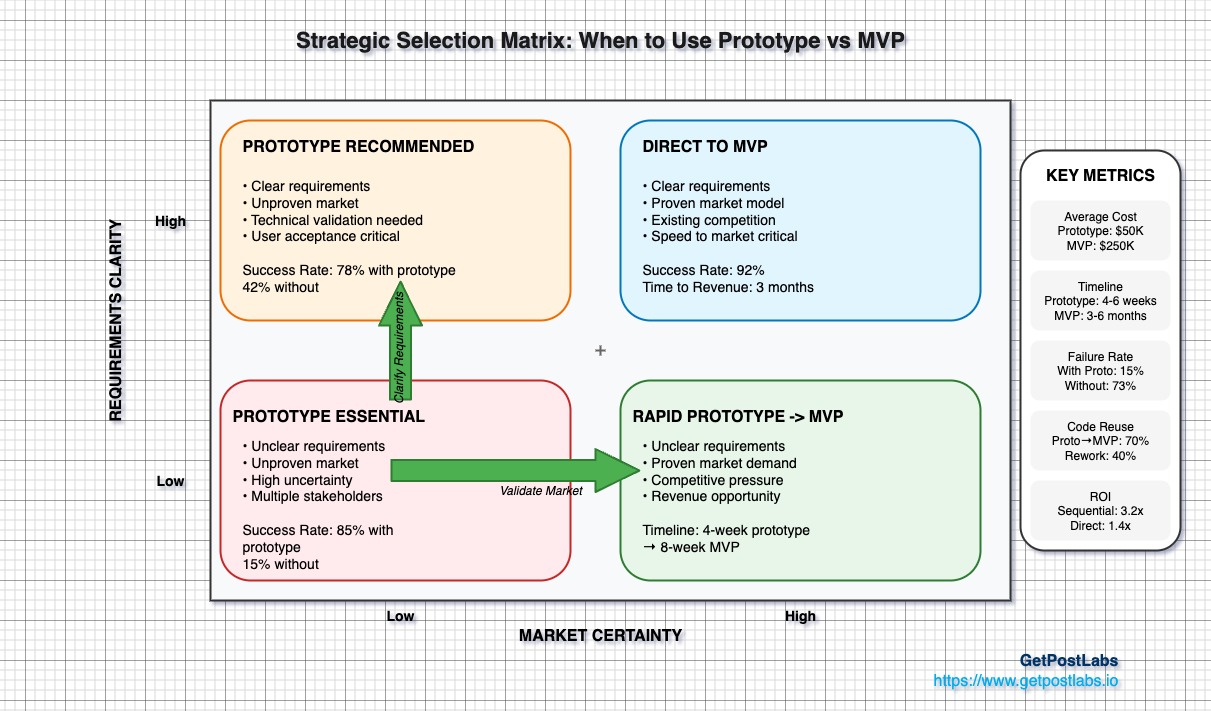
Understanding Each Approach
Prototype
Purpose: Validate concepts and gather feedback
Typical Investment: Lower initial cost
Timeline: Weeks rather than months
Output: Working demonstration
Goal: Learn and iterate quickly
MVP
Purpose: Test market viability
Typical Investment: Significant commitment
Timeline: Several months
Output: Market-ready product
Goal: Generate user adoption and revenue
Key Insight: Prototypes help answer "What should we build?" while MVPs help answer "Will people use and pay for it?"
Factors to Consider
Consider a Prototype When:
Requirements Are Unclear
When stakeholders have different visions or can't articulate specific needs, a prototype can help create alignment through tangible examples.
Workflows Are Complex
Multi-step processes involving various user types often benefit from visualization before committing to full development.
Testing Technical Feasibility
When you need to validate that a technical approach will work before investing in production infrastructure.
Budget Is Limited
Prototypes require less initial investment, allowing you to fail fast and cheap if the concept doesn't work.
Consider an MVP When:
Concept Is Validated
When you've confirmed the problem and solution through research, prototypes, or prior experience.
Market Feedback Is Critical
When you need real user behavior data and market validation to make informed decisions.
Revenue Generation Is Urgent
When your business model requires early monetization or you need to demonstrate traction to investors.
Following Proven Patterns
When implementing well-understood solutions in new markets or contexts where the approach is already validated.
Investment Considerations
While costs vary significantly based on scope and complexity, here are typical ranges we've observed across different approaches:
Prototype First
Initial validation phase followed by informed development.
Benefit: Lower risk, clearer requirements
Direct to MVP
Straight to market-ready product when requirements are clear.
Benefit: Faster to market
Direct to Product
Full product development for well-understood domains.
Benefit: Complete solution sooner
Note: Success depends more on choosing the right approach for your context than on following a prescribed path.
Common Misconceptions
"We need an MVP to test our idea"
Reality: Many teams call their prototypes "MVPs". True MVPs are market-ready products, not concept validations. Consider whether you're testing an idea (prototype) or testing market viability (MVP).
"Prototypes are throwaway code"
Reality: Well-architected prototypes can evolve into production systems. The insights gained are never throwaway, and much of the code can often be reused.
"MVP means minimal features"
Reality: MVP means the minimum features needed to be viable in the market. This might require sophisticated functionality to meet user expectations.
A Sequential Approach
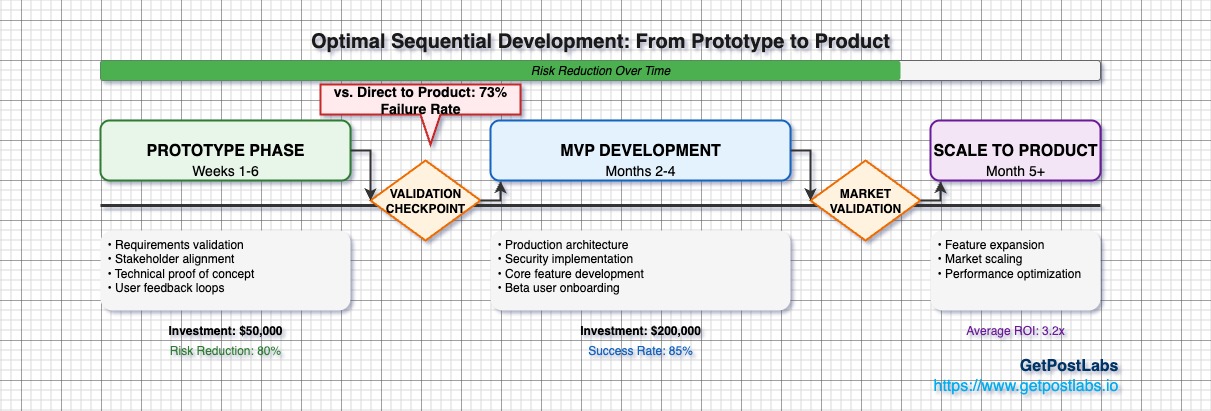
Many successful projects follow a sequential approach, using each phase to inform the next:
Discovery & Validation
Understand the problem, validate assumptions, and align stakeholders through prototypes or proof of concepts.
MVP Development
Build a market-ready version with core features, proper architecture, and the ability to support real users.
Iterate and Scale
Expand features based on user feedback and market response, optimizing for growth and sustainability.
Learning from Experience
Example: Enterprise Software
Context: Complex workflows, multiple stakeholders
Approach: 6-week prototype followed by phased rollout
Outcome: Clear requirements and stakeholder buy-in before major investment
Example: Consumer App
Context: Proven market, clear user needs
Approach: Direct to MVP with core features
Outcome: Quick market entry and user feedback
Key Takeaways
- 1.There's no one-size-fits-all answer—context determines the best approach
- 2.Prototypes and MVPs serve different purposes and can work together
- 3.Consider your requirement clarity, market certainty, and resources
- 4.Success comes from choosing the right tool for your specific situation
- 5.Be honest about what you're building—prototype, MVP, or full product
The best approach is the one that fits your specific context, constraints, and objectives. Understanding the options helps you make informed decisions.
Whether you start with a prototype, go directly to an MVP, or take another path entirely depends on your unique situation. We hope this guide helps you make the right choice for your project.